How to Avoid a Scam: Advice from a Subject-matter Expert
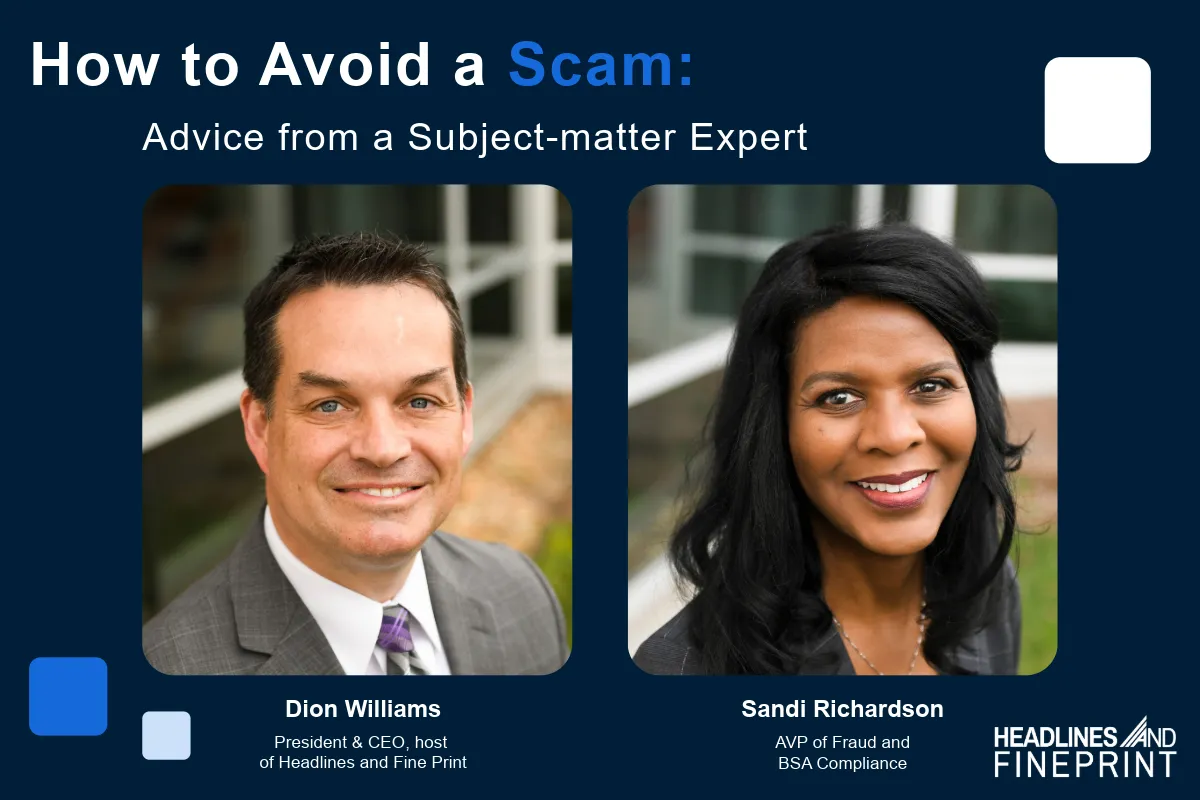
Fraud has become all too common. What can our members do to protect themselves? What red flags should they be looking for?
In this episode of Headlines and Fine Print, PACU President & CEO Dion Williams interviews AVP of Fraud and Bank Secrecy Act (BSA) Compliance Sandi Richardson, and together they dive into the fine print of fraud so members are better equipped to protect themselves and loved ones.
How Would You Define Fraud, and What’s the Most Common Way You See It Manifest?
Sandi: In its simplest definition, fraud is the deliberate act of intentionally taking something of value in an unauthorized way through deception.
Fraud is so rampant today, and it can be carried out in so many ways. Some of the ways we see it most in PACU is through check fraud, romance scams, cryptocurrency investment scams and tech support scams.
Dion: I know that through working with you over these recent years, another area you are very passionate about is elder care and scams targeting older people. Talk about that a little bit.
Sandi: Yes. I believe elderly members are our primary target at the credit union. Fraudsters see them as easy prey for several reasons: their age and a different generational outlook, which often makes them more trusting, stemming from a time when a handshake was a guarantee of trust. While we now live in a different world, this trusting instinct remains strong in older individuals. Additionally, loneliness can be a factor, especially if they’ve lost family or friends, leading them to seek companionship or attention.
Many are also less familiar with computers, making them more vulnerable to manipulation. This trust can be exploited when they’re told to perform tasks online, often assuming they’re legitimate. Also, some older individuals may experience cognitive decline, which fraudsters also take advantage of.
If Members Suspect or Detect Fraud, What Should Their First Step Be?
Sandi: A trusted contact program allows elderly members to select someone they trust, like a family member or friend, to help secure their accounts and check in on them.
This contact can review account activity for unusual signs. Spending time talking with elderly individuals helps better understand their lives. It’s important for the trusted contact to discuss how they’ll help, not to restrict independence, but to support and be an ally.
What Does the PACU Fraud Team Do to Protect Members Proactively?
Sandi: We have a great BSA and Fraud software suite with a wide range of analytics that help us identify various types of fraud.
We are constantly monitoring transactions for out-of-pattern behavior, anomalies and activity that doesn’t align with what you might expect from that individual. We’re constantly doing that. At PACU, we know that fighting fraud is a team effort. The frontline is our first line of defense against financial crime. On the frontline, if someone notices out-of-pattern activity, behavior or transactions, they may submit to us what we call an unusual activity referral. Then my team investigates their activity.
What are Some Fraud Prevention Best Practices?
Sandi: Older people are a huge target, but it can happen to all of us. There are a few tips that we like to share to help prevent fraud:
- Don’t be overconfident. If you think that it could never happen to you or that you would never fall for a scam, then you’re making yourself an easier target by lowering your guard.
- Don’t be complacent. You want to check your bank account activity regularly and look for any unusual activity.
- Don’t talk to strangers. There are so many ways nowadays for untrustworthy people to talk to you without you ever knowing who they really are. At the end of the day, we don’t know who’s really on the other side of that text, that call or the internet. We regularly put ourselves in a vulnerable position. If someone calls you and they’re not in your contact list, let it go to voicemail, then decide whether to call them back. I think that you should consider every call, every email, every text a scam until it’s proven otherwise.
Dion: And artificial intelligence is making it all the more challenging, right?
Sandi: With artificial intelligence, not only can someone sound like a family member or friend, but the technology can also clone a person’s appearance and you may think you’re looking at or talking to a family member or friend. Artificial intelligence has many benefits, but in the wrong hands, it can yield some really scary results.
What Final Advice Do You Have for Our Members?
Sandi: I would say that you just can never be too careful. Fraud is everywhere, and it’s going only to get worse. It’s already at super high levels, and it’s really scary to imagine it only getting worse. It’s a mindset you have to adopt: not clicking on attachments in emails or links in texts and emails, unless it is something that you were expecting from a legitimate source. Sadly, we have to operate in this way.
Dion: Right now, I know the “trust but verify” adage is very true, but it’s hard, too. Earlier, you mentioned that the handshake agreement no longer carries as much weight as it used to.
Today, it’s almost suspicious to trust first. That’s kind of a change in mindset from how things used to be.
Sandi: Right. I very much believe in being suspicious first, but not unkind, rigid or unwelcoming. Just try not to be too trusting. We have to really consider the world we’re living in now and take the right steps to protect ourselves.
Dion: I know from our Member Relationship Team (MRT) that we tell folks, “If you get something that’s suspicious, don’t just take it at face value.” Contact us directly instead. You know the person at the branch, you know the person on the MRT. Reach back out to us, hang up or don’t respond to that text directly. And remember: we don’t text our members!
Sandi: Exactly. Imposter scams are very popular right now as well. For our members who receive calls, sometimes they get one saying it’s from the fraud department or another department about their account activity. What they should always do is hang up. Say “Okay, thank you,” hang up the phone, then call the call center back and have them transferred to the fraud department, just to verify that it’s the fraud department calling them. I’m always really pleased when I’m talking to a member who wants to take that course. I encourage it.
Catch Us Next Time on Headlines and Fine Print
We’re going to have a series of guest hosts in the coming months to bring you more education like this. Want to listen to past episodes? Check out our Spotify and YouTube.
In the meantime, know that we’re here looking beyond the headlines into the fine print so members can get the information they need to be well-informed financial consumers.
Keep reading below for more insight into this episode’s guest, Sandi Richardson.
What Character in Entertainment Have You Drawn Inspiration from Related to Your Field?
Sandi: James Bond. I grew up watching those movies, and when I was in high school, I even considered pursuing a career with the CIA, but decided against it because I didn’t want to live a double life. James Bond inspired me to play a part in fighting financial crime, and I have always enjoyed investigation, research, and regulatory compliance.
About Our Guest
Sandi has worked with PACU for over seven years and in this industry for 12 years. She focuses on combating financial crimes, such as tax evasion and money laundering.
Sandi: I have always wanted my work to be meaningful, but I also always had a passion for research and investigation, along with helping people, so a career in compliance felt like a natural fit.
Fraud Awareness Spotlight
Our PACU fraud specialists work tirelessly to help you and your loved ones avoid becoming victims of fraud. As technology gets more sophisticated and fraudsters find new ways to try to steal your identity and hack into your accounts, it’s increasingly important to check your accounts regularly and report any suspicious activity as soon as possible.
Check out our Advantage Insights blog for posts about preventing fraud and more!

Related Resources
-

PACU Kicks Off Annual Member Appreciation Days with Mooresville Branch
On Friday, March 13th, we held the first of our branches’ annual Member Appreciation Days at our Mooresville location. Thank you to all our members who came out today and celebrated with us. We hope you felt that sense of belonging and how appreciated you are. Next up is our Charlotte branch’s Member Appreciation Day
-
How to Avoid a Scam: Advice from a Subject-matter Expert
Fraud has become all too common. What can our members do to protect themselves? What red flags should they be looking for? In this episode of Headlines and Fine Print, PACU President & CEO Dion Williams interviews AVP of Fraud and Bank Secrecy Act (BSA) Compliance Sandi Richardson, and together they dive into the fine
-

Five Reasons Teens Should Learn About Money Before Graduation
High school teaches math, history and science, but most teens graduate without ever learning how to manage a paycheck. Here’s why early financial education matters more than ever:
-
PACU Day 2026
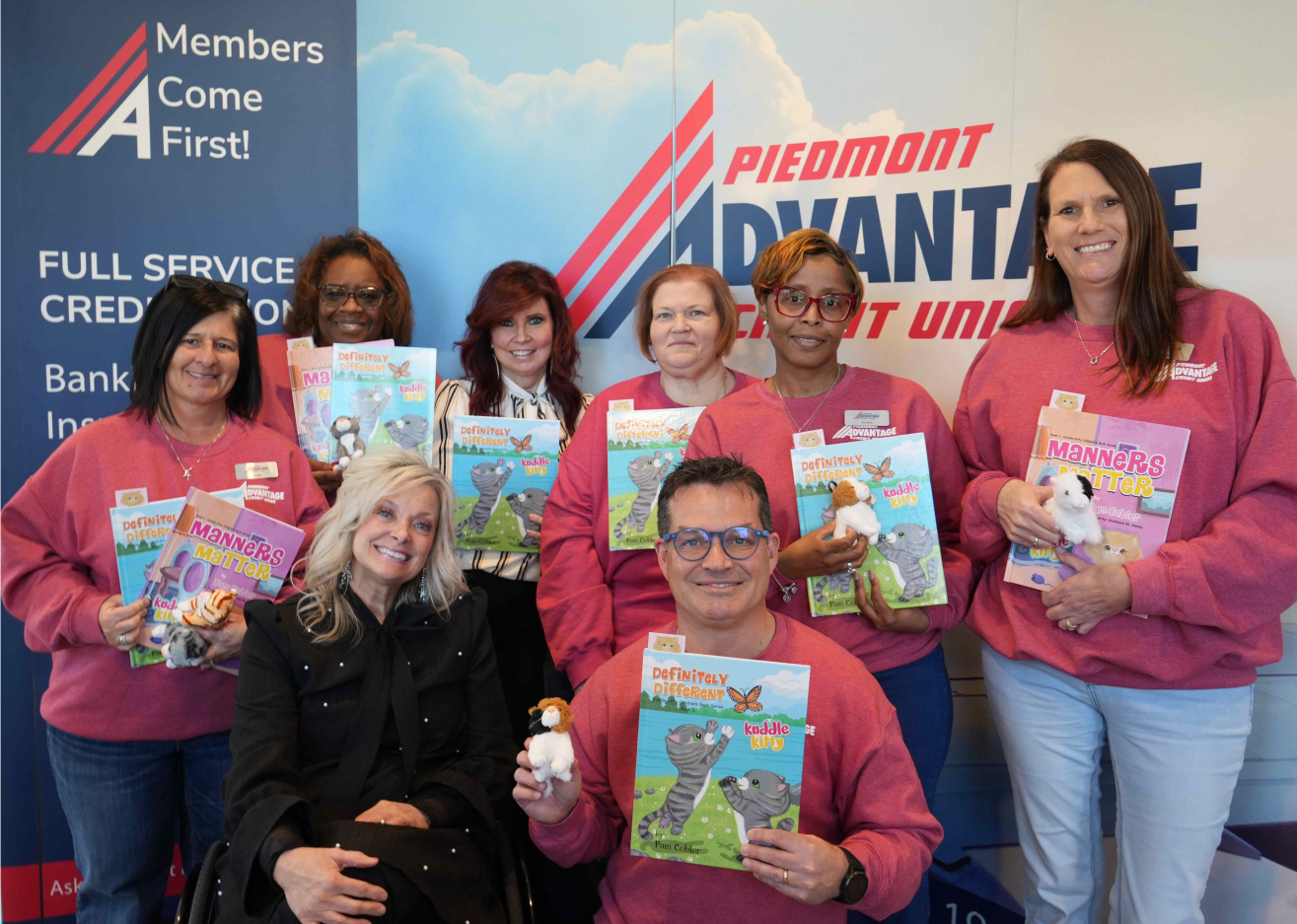
Presidents Day is often a time to reflect on leadership and the values that shaped our nation. At Piedmont Advantage Credit Union, it has taken on a more personal meaning. Each year on Presidents Day, Piedmont Advantage closes its operations and brings together employees from every branch and department for PACU Day, an annual gathering
Headquartered in Winston-Salem, North Carolina, and founded in 1949 within the aviation industry, Piedmont Advantage Credit Union (PACU) serves member-owners, who reside, work, worship, attend school or operate a business in one of the six counties it serves in North Carolina or who are employed by one of its many employer companies. These six counties are Davie, Forsyth, Guilford, Iredell, Mecklenburg and Rockingham.